
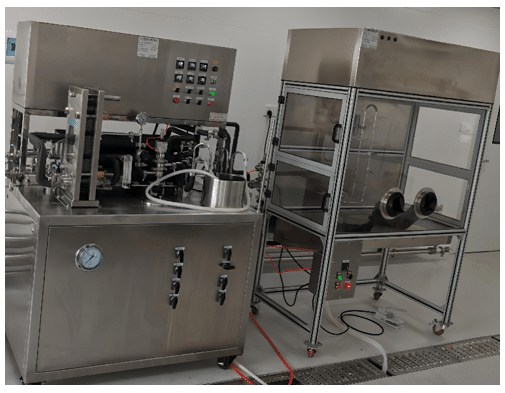
YOGURT CHILLER

Noggrann yogurt chiller with two-stage cooling for R&D and pilot-scale yogurt production

Precision Lab & Small-Batch Yogurt Chiller


Two-Stage Casing Heat Exchange System


Introducing our advanced chilling solution for R&D and small-scale production. This state-of-the-art laboratory Yogurt machine chiller utilizes a sophisticated casing-type heat exchange cooling system with a two-stage cooling structure—consisting of a pre-cooling section and a cold section. Its compact design requires only ice water, tap water, and electricity for operation.
This system provides stable and repeatable experimental data, supporting the precise development of stirred yogurt products. As a vital piece of Yogurt processing equipment, it ensures highly accurate temperature regulation, process consistency, and efficient production.


Rapid Cooling & Reliable Data


Efficient and Repeatable Processes

It excels in achieving Rapid cooling yogurt temperatures quickly and precisely, a critical step in halting fermentation at the perfect moment. This robust unit functions as an effective, small-scale Industrial yogurt cooling system, making it an ideal solution for research, testing, and pilot-scale yogurt processing operations.


Key Features & Applications

  1. Efficient Cooling & Demulsification – Rapidly cools yogurt to the desired filling temperature while simultaneously completing the demulsification and cooling
  2. Adjustable Shear Forces – The yogurt smoothing valve allows for customized shear forces, affecting the product texture.
  3. Texture & Viscosity Testing – Evaluates the effects of different filling temperatures and shear forces on yogurt texture and viscosity.
  4. Versatile Testing Capabilities – Supports comparative studies on mixed yogurt, Greek yogurt, and dairy desserts.


Device Features

  1. High-Quality Components – Utilizes advanced configurations for stable and reliable performance.
  2. Compact & Self-Contained – Requires minimal space, covering only 2-3 square meters.
  3. Simple Installation – Operates with just tap water, ice water, and electricity, making it ideal for a mobile laboratory.
  4. Small Batch Testing – A minimum feed capacity of 3-5 liters allows for quick experiments.
  5. Advanced Control System – Fully automated operation, accurate temperature control with a ±0.5°C error margin.
  6. Scalability – Experimental data is highly reproducible and can be directly scaled up to industrial production.
  7. Effective Cleaning System – The CIP (400L/H) function operates at 20 times the product flow rate, ensuring a thorough and efficient cleaning process.


Technical Specifications

DescriptionData
Standard CapacityRated 20L/H (10-40L adjustable), minimum test capacity of 3-5L
Sterilization Temperature Max.100°C
Filling Temperature10-90°C
CIP Flow Rate400L/H
Max. Line Pressure7bar
Power6KW,415V,3PH,50Hz
Dimensions1700mm (H) × 1200mm (L) × 950mm (W)


Frequently Asked Questions

A yogurt chiller rapidly cools fermented yogurt to a precise filling temperature, halting fermentation at the right moment while completing demulsification to achieve the desired texture and consistency before packaging.

A two-stage casing heat exchange system cools yogurt in a pre-cooling section followed by a cold section, allowing more controlled, gradual temperature reduction than single-stage cooling — this helps preserve product consistency and prevents shock-cooling defects in the final texture.

Filling temperature for stirred and Greek-style yogurt typically ranges from 10°C to 90°C depending on the product type, with precise control (±0.5°C) required to achieve consistent viscosity and mouthfeel across production batches.

An adjustable yogurt smoothing valve applies controlled shear force during cooling, breaking down the coagulated protein structure to a customized degree — higher shear typically produces a smoother, less viscous texture, while lower shear preserves more body and thickness.

Yes — a lab-scale yogurt chiller with adjustable shear and temperature settings supports comparative testing across mixed yogurt, Greek yogurt, and dairy dessert formulations, making it suitable for R&D teams developing multiple product lines on one system.

Unlike larger industrial systems, a compact lab-scale yogurt chiller typically requires only tap water, ice water, and electricity — no compressed air or separate refrigeration plant — making it suitable for mobile or space-constrained laboratory setups.

A CIP (Clean-in-Place) system operating at roughly 20 times the normal product flow rate circulates cleaning solution through the system without disassembly, ensuring thorough sanitation and fast turnaround between different yogurt formulations or trial batches.

Yes — because the two-stage cooling and shear parameters are precisely controlled and recorded, experimental data from a lab-scale yogurt chiller is designed to be directly reproducible at industrial production scale, reducing the risk and cost of scale-up trials.

crossmenu