

Yes, lactose-free milk can be sterilized using a lab-scale UHT (Ultra-High Temperature) production line method. These systems are designed to replicate industrial UHT processing on a smaller scale for research, product development, and quality control, offering features like precise temperature control and aseptic packaging simulation.

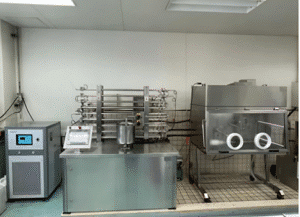
Explore Noggrann's UHT LAB SCALE STERILIZER for more information.
For dairy and protein product, The homogenizer is often placed downstream (after) the heating section of the UHT system but before the final cooling section to ensure stability and re-homogenization after the intense heat treatment.
The rated capacity is 20 liters per hour, with a minimum batch size of only 3 liters. capacity can be customised for pilot plant.
The critical sequence is Homogenizer, followed by the UHT System, which feeds the sterile product directly into the Aseptic Bottle Filler. The homogenizer is often placed before or after the UHT heater depending on the product process.
Yes, lab-scale UHT systems are ideal for this purpose. They allow food scientists and R&D departments to:
Lab-scale UHT equipment addresses the challenges of lactose-free milk production through advanced control features:
No, UHT milk does not require preservatives. The high-temperature treatment and aseptic packaging process kill all microorganisms, ensuring the product is safe and shelf-stable for months without refrigeration.
Once opened, UHT lactose-free milk should be treated like fresh milk. It must be refrigerated at 1-5°C and consumed within 5 to 7 days.
Direct heating systems, such as steam injection or steam infusion, are generally preferred for lactose-free milk. The resulting simple sugars (glucose and galactose) are highly reactive and accelerate browning (Maillard reaction) during heating. Direct systems achieve extremely rapid heating and cooling (high temperature, short time), which minimizes the overall thermal exposure and thus reduces chemical damage and off-flavors compared to indirect heating methods.
Homogenization is a critical step that typically occurs before the final UHT sterilization (around 55-65°C). The homogenizer breaks down fat globules into smaller, uniformly distributed particles under high pressure. This mechanical treatment improves the uniformity of the milk, enhances product stability, and prevents creaming or fat separation during long-term ambient storage of the UHT product.
The fundamental CIP process (prerinse, caustic wash, acid wash, final rinse, sanitize) remains the same, but the frequency and parameters might need adjustment. Because protein buildup (fouling) can be more pronounced with some lactose-free formulations (especially plant-based ones), the CIP sequence must be robust. The system automation (PLC control) ensures precise control of temperature, time, and chemical concentration to effectively remove stubborn deposits without damaging the stainless steel components, which is critical for maintaining hygiene and operational efficiency.
The primary challenges are protein aggregation (gelation), sedimentation, and potential off-flavor development