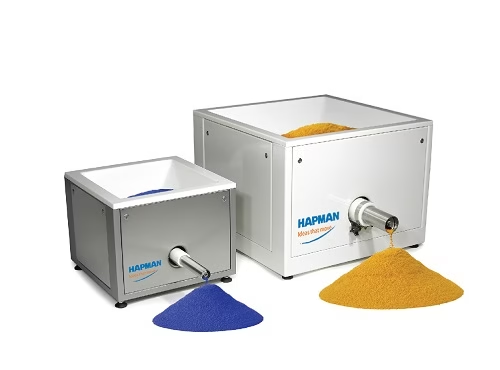
Our full line of gravimetric and volumetric screw feeders is engineered for industrial sized processing of dry materials. These include both continuous or batch operations. When your system needs a reliable feeding system we can help.
Measure with precision: Gravimetrically weigh and measure free-flowing and sluggish bulk solids, granules and powders.
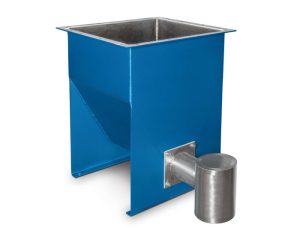
U-trough screw feeder
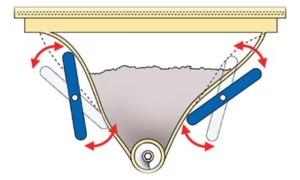
1. Optimize product flow. External paddle agitators reduce bridging, limit material contact surfaces, and reduce opportunity for contamination.
2. Increase feeder performance with integrated load cells and instrumentation. Provides immediate feedback that material was delivered.
3. Handle spreading and seasoning applications with optional elongated distribution nozzle.
4. Optional level sensors help workers keep hopper full and feed rate consistent.
5. Choose from many easy-to-change-out auger options—flat, square, or round (with or without a center core), continuously welded, polished or milled from solid bar stock.
Integrate the Tubular Chain conveyor with other bulk material equipment from Noggrann like the Flexible Screw Conveyor, FIBC DISCHARGER, BULK BAG FILLERS, or Tubular drag conveyor for a complete conveying system.
A screw feeder is a precision device used to dose or meter powders, granules, or bulk solids at a controlled rate. It uses a rotating screw (auger) inside a tube or trough. As the screw turns, material is drawn from the hopper and delivered at a consistent volume per revolution.
For difficult materials, external agitators or vibration can prevent bridging, and polyurethane or abrasion-resistant hoppers improve durability. Screw feeders are also known as auger feeders, metering screws, or powder dosing feeders.
Screw feeders are suitable for a wide range of bulk materials, including:
• Fine powders (cement, flour, silica, talc)
• Granules and pellets
• Minerals and crystalline products
• Flakes and chips
• Abrasive powders (metal powders, ceramic fines)
• Hygroscopic or moisture-sensitive powders
• Cohesive or sticky materials using special screw designs
Both free-flowing and poor-flowing materials can be handled with proper screw geometry and hopper design.
High-performance screw feeders typically include the following design features:
• Accurate volumetric and/or gravimetric feed control
• Hopper geometry that maintains natural flow and keeps the auger consistently filled
• Quick-release or tool-free components for fast cleaning
• Designs that minimise material segregation or degradation
• Ability to run continuously or in discrete batches
• Strong performance under full-hopper or full-load startup
• Options for food, chemical, or sanitary applications
• Low maintenance requirements
Correct sizing depends on:
• Required feed rate (kg/hr or m³/hr)
• Bulk density and particle characteristics
• Material flow behaviour (free-flowing or cohesive)
• Accuracy requirements
• Available installation space and discharge height
• Duty cycle, environment, and required lifespan
Proper screw pitch and diameter selection are critical for stable, uniform flow.
Typical accuracy ranges are:
• Volumetric feeding: ±1% (depending on material consistency)
• Gravimetric feeding (loss-in-weight): ±0.25–1%
Accuracy depends on screw design, material flow properties, and motor control type (VFD or servo).
Yes. Screw feeders are widely used for:
• Continuous metering
• Batch dosing
• Loss-in-weight systems
• Gain-in-weight batching
They provide accurate, repeatable material delivery across food, chemical, plastic, mining, and pharmaceutical processes.
Maintenance is straightforward because the auger section typically has no internal bearings. Most designs can be disassembled without special tools.
Recommended maintenance:
• Inspect auger and liner for wear
• Remove material buildup
• Check seals, drive components, and bearings
• Lubricate gearbox/motor as required
• Use quick-release covers or removable screws to simplify cleaning
Common solutions include:
• Hopper agitation or vibration
• Flexible-wall hopper construction or flow-aid devices
• Proper screw pitch, tapered flighting, or twin-screw design
• Sufficient throat opening and mass-flow hopper geometry
Good flow conditioning is crucial for cohesive or moisture-sensitive powders.
Common causes include:
• Variations in bulk density
• Moisture absorption or humidity effects
• Bridging or ratholing in the hopper
• Incorrect or worn screw pitch
• Motor speed fluctuations
• Material packing or compaction
Corrective actions often involve adjusting the hopper/feeder interface or adding flow-aid devices.
Yes. Screw feeders are frequently paired with:
• Load cells for loss-in-weight control
• Floor or platform scales for gain-in-weight dosing
• PLC or SCADA control for automated metering
This combination provides highly precise, closed-loop feeding.
A properly maintained screw feeder typically lasts 8–15 years, depending on:
• Abrasiveness of the handled material
• Operating hours and speed
• Maintenance frequency
Wear components such as screws and liners can be replaced to extend service life.
Yes. Many screw feeders are available in hygienic or sanitary designs featuring:
• Stainless steel construction
• Smooth welds and polished contact surfaces
• FDA-compliant seals and materials
• Easy-clean, tool-free assemblies
These are suitable for food powders, additives, nutraceuticals, and active ingredients.
Yes. Feed rate can be adjusted using:
• Variable frequency drives (VFD)
• Servo motors for high-precision control
Variable-speed operation is essential for batching, recipe-based systems, and flexible production environments.
A screw feeder accurately regulates material flow (dosing), typically at lower feed rates.
A screw conveyor, by definition, moves material for bulk transport but does not control flow rate with the same precision.
While a generic screw conveyor is one method of transport, Tubular Drag Conveyors are often the superior choice for high-capacity, gentle, and enclosed transfer of bulk materials.
Key differences: