
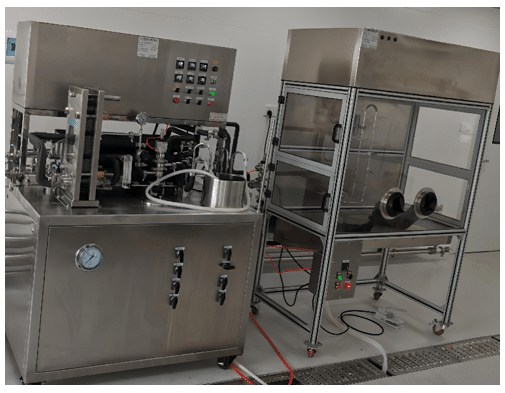
| Description | Data |
| Standard Capacity | Rated 20L/H (10-40L adjustable), minimum test capacity of 3-5L |
| Sterilization Temperature Max. | 100°C |
| Filling Temperature | 10-90°C |
| CIP Flow Rate | 400L/H |
| Max. Line Pressure | 7bar |
| Power | 6KW,415V,3PH,50Hz |
| Dimensions | 1700mm (H) × 1200mm (L) × 950mm (W) |
A yogurt chiller rapidly cools fermented yogurt to a precise filling temperature, halting fermentation at the right moment while completing demulsification to achieve the desired texture and consistency before packaging.
A two-stage casing heat exchange system cools yogurt in a pre-cooling section followed by a cold section, allowing more controlled, gradual temperature reduction than single-stage cooling — this helps preserve product consistency and prevents shock-cooling defects in the final texture.
Filling temperature for stirred and Greek-style yogurt typically ranges from 10°C to 90°C depending on the product type, with precise control (±0.5°C) required to achieve consistent viscosity and mouthfeel across production batches.
An adjustable yogurt smoothing valve applies controlled shear force during cooling, breaking down the coagulated protein structure to a customized degree — higher shear typically produces a smoother, less viscous texture, while lower shear preserves more body and thickness.
Yes — a lab-scale yogurt chiller with adjustable shear and temperature settings supports comparative testing across mixed yogurt, Greek yogurt, and dairy dessert formulations, making it suitable for R&D teams developing multiple product lines on one system.
Unlike larger industrial systems, a compact lab-scale yogurt chiller typically requires only tap water, ice water, and electricity — no compressed air or separate refrigeration plant — making it suitable for mobile or space-constrained laboratory setups.
A CIP (Clean-in-Place) system operating at roughly 20 times the normal product flow rate circulates cleaning solution through the system without disassembly, ensuring thorough sanitation and fast turnaround between different yogurt formulations or trial batches.
Yes — because the two-stage cooling and shear parameters are precisely controlled and recorded, experimental data from a lab-scale yogurt chiller is designed to be directly reproducible at industrial production scale, reducing the risk and cost of scale-up trials.