

A lab spray dryer is a specialized piece of equipment used in laboratories to convert liquid substances into dry powders through a process called spray drying. This method involves atomizing a liquid into fine droplets and rapidly drying them in a stream of hot air, resulting in a dry powder.
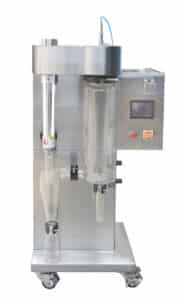
The SP-1500 is a compact, standalone laboratory spray dryer featuring a large colourful LCD touch screen for easy operation. Its key components, including compressors, fans, heaters, control systems, and nozzles, are all imported. This high-quality equipment offers excellent stability and a high product collection rate, earning widespread recognition and praise from customers.
The SP-1500 spray dryer is ideal for producing fine particle powders in laboratories at universities, research institutes, and food, pharmaceutical, and chemical enterprises. It is suitable for drying various solutions, emulsions, and suspensions. Additionally, it is well-suited for heat-sensitive substances, such as biological products, biopesticides, and enzyme preparations.
| Description | Data |
| Evaporation Water Rate | 1500ml/h |
| Inlet Air Temperature | 30°C – 280°C |
| Outlet Air Temperature | 30°C – 140°C |
| Heating Temperature Accuracy | ±1°C |
| Drying Time | 1.0-1.5s |
| Peristaltic Pump Feed Rate | 300-1500mL/h |
| Minimum Feed Rate | 50mL |
| Dry Air Flow | Max.0-330m3/h max. 686Pa |
| Compressor Required | 4.2m3/h, 2-5bar |
| Power Supply | 3.5kw, 230v-50Hz |
| Dimensions (L × W × H) | 650 × 500 × 1550mm |
| Weight: | 120kg |
The SP series spray dryer is an advanced drying system, continuously refined through multiple enhancements based on domestic and international spray dryer designs. It is ideal for low-temperature drying and processing of viscous liquid materials.
Air Filtration & Heating. Cold air passes through a filtration before entering the heater, where it is heated to the desired temperature.
Air Distribution. The heated air flows into the distributor at the top of the spray tower, ensuring uniform distribution. The hot air then moves spirally downward inside the tower.
Spray Drying Process. Material droplets come into direct contact with the hot air, initiating rapid heat exchange. The water content in the material vaporizes almost instantly, ensuring efficient drying within an extremely short time.
Product Separation & Discharge. The dried finished product is separated via a cyclone separator and discharged, waste steam is removed through an induced draft fan.
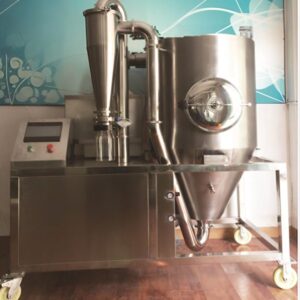
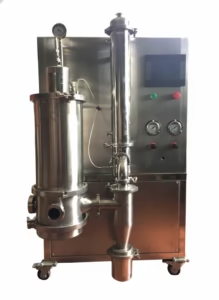
The SP-2000 laboratory low-temperature spray dryer is a high-performance unit. The system features a compact, fully self-contained design that operates without the need for external auxiliary equipment. It is equipped with a large color LCD touchscreen for intuitive operation. All key components—including the peristaltic pump, heater, and nozzle—are sourced from reputable, internationally recognized brands, ensuring excellent reliability
The equipment is widely recognized for its outstanding stability and high product collection rate. It supports two operating modes: fully automatic and manual, enabling easy operation and convenient monitoring of the entire experimental process.
In laboratory applications, it is suitable for drying traditional Chinese medicine extracts, natural product extracts, fruit juices, and similar materials. It produces free-flowing powder particles at low temperatures of 50–110°C, achieving exceptionally high yields
It provides a safe and highly convenient drying method for heat-sensitive materials such as biological products, high-sugar TCM extracts, heat-sensitive polymers, and materials that tend to volatilize when heated.
Explore Noggrann UHT LAB SCALE STERILIZER for your lab application.
A lab spray dryer converts a liquid feed (solution, suspension, or emulsion) into a dry powder. It works by atomizing the liquid into fine droplets and instantly evaporating the solvent using a stream of hot air or gas.
Yes. Due to the extremely short residence time (typically 1 to 3 seconds) in the drying chamber, heat exposure is minimal, making it ideal for sensitive materials like enzymes, proteins, and vitamins.
Spray-dried powders usually range from 10 to 500 microns in diameter, with the size controlled by the feed rate, atomization pressure, and the specific nozzle used.
They are essential for R&D in the Pharmaceutical (microencapsulation, APIs), Food & Beverage (flavors, dairy), Chemical, and Biotechnology industries due to the control and scalability they offer.
Inlet temperature dictates the drying rate; too high can cause degradation or sticking. Outlet temperature reflects the final moisture content; a lower outlet temperature usually indicates higher residual moisture.
To increase yield, ensure the cyclone separator seals are airtight, optimize the outlet temperature to reduce product sticking to chamber walls, and verify the correct balance between air and feed flow rates.
Clogging is typically caused by high-viscosity feeds, high solids content, or particulate matter in the feed solution. Using proper pre-filtration and adjusting the feed concentration are the best solutions.
Yes. Due to the extremely short residence time (typically 1 to 3 seconds) in the drying chamber, heat exposure is minimal, making it ideal for sensitive materials like enzymes, proteins, and vitamins.
For highly heat-sensitive materials, low temperature with vacuum spray drying technology is employed. This allows for powder production at temperatures of 50–110°C, significantly reducing thermal stress