

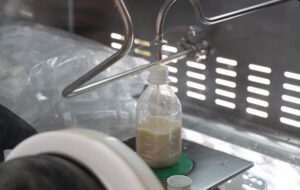
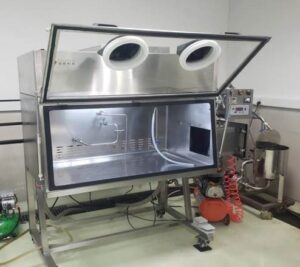
The Noggrann lab-scale aseptic bottle filler is specifically designed to fill bottles with sterilized products in a controlled, sterile environment. As a result, it completely prevents contamination during operation.
This advanced lab-scale aseptic filler sterilizes both the product and the bottle separately before combining them. Consequently, it guarantees high-quality aseptic filling. Furthermore, the entire process occurs in a highly secure area under sterile airflow.
The Noggrann semi-automatic lab-scale aseptic filler system is engineered for precision R&D. Because of this, it reliably protects product integrity during small-batch sterile bottling.
Operation is exceptionally easy using a simple footswitch, while a solenoid valve controls the filling head. Furthermore, its ultra-clean design integrates a multi-stage air filtration system, an ozone generator, and an ultraviolet germicidal lamp. Together, these components ensure complete sterilization of the working area.
This versatile lab-scale aseptic bottle filler is ideal for filling milk, beverages, fruit juices, spices, and other sensitive liquids. It easily supports various bottle types and volumes.
Therefore, it is widely used in university laboratories and enterprise R&D departments. Ultimately, it successfully simulates full-scale industrial aseptic production at a compact laboratory scale.
Explore Noggrann's UHT LAB SCALE STERILIZER for your production
The lab-scale aseptic filler is designed for R&D, pilot production, and small-batch sterile filling. It is used to create aseptic samples of UHT milk, juices, sauces, and biopharmaceutical liquids for formulation testing, shelf-life evaluation, and quality validation.
The system sterilizes bottles, caps, and product-contact surfaces before filling. All operations occur inside a protected chamber with HEPA-filtered air and validated sterilization steps, ensuring that ambient air does not compromise sterility.
The system provides automated CIP and SIP sequences using standard cleaning agents, hot water, or steam. This ensures thorough internal sanitation with minimal manual handling, enabling fast turnaround between test runs.
Aseptic fillers are widely used for a broad range of products, including:
The process generally involves three main stages: