
UHT PRODUCTION LINE

UHT PRODUCTION LINE

Lab-Scale UHT Product Line

for Dairy & Beverage R&D


Advanced UHT Production Line

The food industry widely uses UHT production line (Ultra-High Temperature) processing to extend the shelf life of various products, including low-acid beverages and foods, while maintaining their quality and nutritional value. This technology is essential for creating shelf-stable products like UHT milk and other beverages.
We designed the lab-scale UHT plant with advanced technology to meet the requirements of universities, research institutes, and enterprise R&D departments. This allows them to simulate industrial manufacturing and conduct research in laboratory settings.


Can lactose-free milk be sterilized by lab scale UHT method?

Yes, lactose-free milk can be sterilized using a lab-scale UHT (Ultra-High Temperature) production line method. These systems are designed to replicate industrial UHT processing on a smaller scale for research, product development, and quality control, offering features like precise temperature control and aseptic packaging simulation.

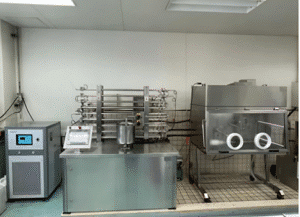
Research, Testing, and Product Development

In university and institute laboratories, as well as enterprise R&D departments, this equipment fully simulates industrial production sterilization. Researchers specifically use it for essential R&D tasks such as taste testing new products, researching product formulations, updating formulas, evaluating product color, and conducting comprehensive shelf-life testing of all UHT processed milk and beverage varieties.


FEATURES:

  • An independent control system with a user-friendly interface, allowing the operation and status display to be carried out on the touch screen.
  • Fully simulate industrial production sterilization in laboratory.
  • Enables continuous processing with minimal product loss.
  • The sterilizer is integrated with CIP and SIP functions online, and configured with a homogenizer and an aseptic filling cabinet.
  • All data can be printed, recorded, and downloaded.
  • With high accuracy and excellent reproducibility, trial results can be scaled up to industrial production.
  • Saves materials, energy, and time for new product development. The rated capacity is 20 liters per hour, with a minimum batch size of only 3 liters.
  • Aseptic filling cabinet with 100-grade purification. Specially designed with an ultra-clean multi-stage air filtration system, ozone generator, and ultraviolet germicidal lamp to completely sterilize the working area, ensuring a continuously sterile environment.
  • Compact design, with minimal space requirement.

UHT Production lineUHT Production Line


Explore Noggrann's UHT LAB SCALE STERILIZER for more information.

Frequently Asked Questions

For dairy and protein product, The homogenizer is often placed downstream (after) the heating section of the UHT system but before the final cooling section to ensure stability and re-homogenization after the intense heat treatment.

The rated capacity is 20 liters per hour, with a minimum batch size of only 3 liters. capacity can be customised for pilot plant.

The critical sequence is Homogenizer, followed by the UHT System, which feeds the sterile product directly into the Aseptic Bottle Filler. The homogenizer is often placed before or after the UHT heater depending on the product process.

Yes, lab-scale UHT systems are ideal for this purpose. They allow food scientists and R&D departments to:

  • Mimic Industrial Production: The equipment can simulate the high temperatures (up to 142°C or higher) and short holding times (seconds) used in commercial production lines, ensuring that lab results are scalable.
  • Optimize Enzyme Dosage: Researchers can test different methods of adding the lactase enzyme (before or after heat treatment) and the required dosage to achieve the desired level of lactose hydrolysis while minimizing processing costs and potential off-flavors (like a "cooked" or "burnt" taste).
  • Evaluate Product Stability: The resulting aseptically packaged product can be stored and monitored for chemical changes (e.g., Maillard browning), flavor degradation, and age gelation during an extended shelf life of several months at ambient temperature.
  • Generate Data: The systems often have data logging capabilities for temperature, flow rate, and time, which is crucial for regulatory documentation and process optimization.

Lab-scale UHT equipment addresses the challenges of lactose-free milk production through advanced control features:

  • Precise Temperature Control: High-accuracy controls (often ±1°C) help strike the optimal balance between microbial inactivation and minimizing heat-induced chemical reactions, which are accelerated by the simple sugars in hydrolyzed milk.
  • Aseptic Dosing: Systems can be configured with sterile dosing equipment to inject the sterile lactase enzyme into the milk after the main UHT sterilization step and just before aseptic packaging. This "post-hydrolysis" method is highly efficient and prevents the enzyme from being denatured by the high heat.
  • Small Batch Sizes: With minimum batch sizes as low as 3-5 liters, these machines save significant amounts of material, energy, and time when developing new formulations, rather than using a full commercial line.
  • Integrated CIP/SIP: Clean-in-place (CIP) and Sterilization-in-place (SIP) functions ensure hygiene and prevent cross-contamination, critical for a commercially sterile product.

No, UHT milk does not require preservatives. The high-temperature treatment and aseptic packaging process kill all microorganisms, ensuring the product is safe and shelf-stable for months without refrigeration.

Once opened, UHT lactose-free milk should be treated like fresh milk. It must be refrigerated at 1-5°C and consumed within 5 to 7 days.

Direct heating systems, such as steam injection or steam infusion, are generally preferred for lactose-free milk. The resulting simple sugars (glucose and galactose) are highly reactive and accelerate browning (Maillard reaction) during heating. Direct systems achieve extremely rapid heating and cooling (high temperature, short time), which minimizes the overall thermal exposure and thus reduces chemical damage and off-flavors compared to indirect heating methods.

Homogenization is a critical step that typically occurs before the final UHT sterilization (around 55-65°C). The homogenizer breaks down fat globules into smaller, uniformly distributed particles under high pressure. This mechanical treatment improves the uniformity of the milk, enhances product stability, and prevents creaming or fat separation during long-term ambient storage of the UHT product.

The fundamental CIP process (prerinse, caustic wash, acid wash, final rinse, sanitize) remains the same, but the frequency and parameters might need adjustment. Because protein buildup (fouling) can be more pronounced with some lactose-free formulations (especially plant-based ones), the CIP sequence must be robust. The system automation (PLC control) ensures precise control of temperature, time, and chemical concentration to effectively remove stubborn deposits without damaging the stainless steel components, which is critical for maintaining hygiene and operational efficiency.

The primary challenges are protein aggregation (gelation), sedimentation, and potential off-flavor development

  • Protein Aggregation: The intense heat of UHT can denature plant proteins, causing them to aggregate and form gels or sediment over time, requiring careful formulation with stabilizers and precise temperature control.
  • Fouling: Protein aggregation can also lead to fouling (buildup) on the heat exchanger surfaces, reducing heat transfer efficiency and requiring more frequent cleaning cycles.
  • Off-flavors: The Maillard reaction and lipid oxidation during UHT can produce undesirable "cooked" or "beany" flavors, which equipment choice (direct UHT is gentler) and ingredient quality can mitigate.
crossmenu